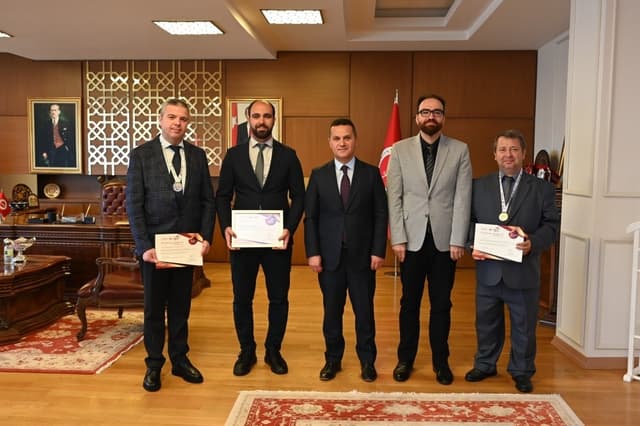
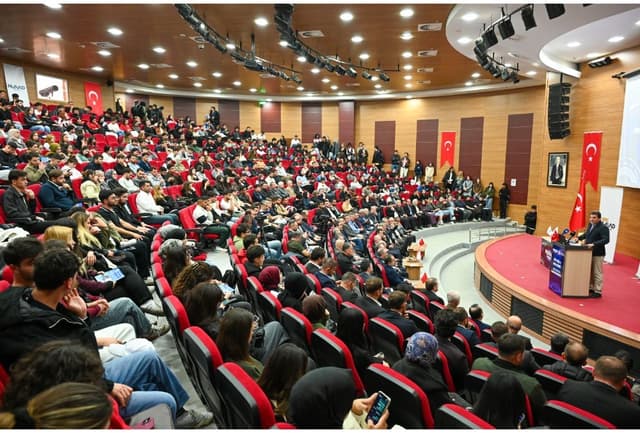
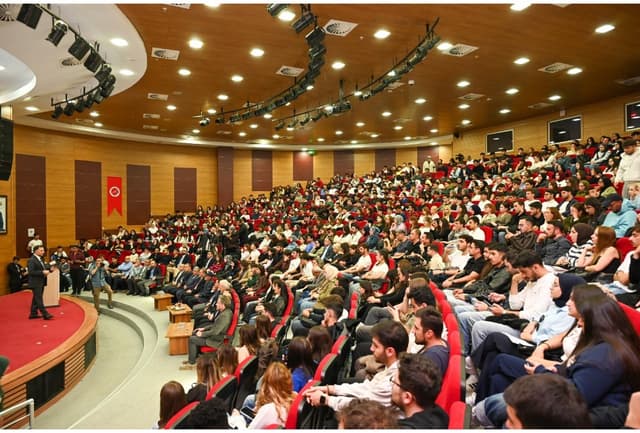
As part of the "Erasmus Days for the Skills of the Future" organized by the Erasmus Coordination Office of Kastamonu University, the activities of the KA220 project titled "Cultivating Peaceful Communities: Non-Violent Communication via Gamification," led by Prof. Dr. Selman Tunay Kamer, were held on October 13, 2026, at the Hoca Ahmet Yesevi Cultural Center.
The program, which focuses on combating peer bullying and developing non-violent communication skills through gamification, was attended by our Vice-Rector Prof. Dr. Selahattin Kaymakcı, Kastamonu Provincial Director of National Education Hasan Gümüş, our University's General Coordinator of International Relations Assoc. Prof. Dr. M. Öztürk Akcaoğlu, Project Coordinator Prof. Dr. Selman Tunay Kamer, our academic and administrative staff, teachers, and students. Project partners from Italy, Germany, and Portugal also participated in the program online.
International project partners presented their work
In the first part of the program, project partners introduced their institutions and shared the work they conducted and the educational materials they developed within the scope of the project with the participants.
A representative from Nextapp in Germany stated that they are working on three main projects that support children and young people in gaining knowledge and skills in behavioral matters. Stating that they are developing game-based educational content specifically for the 12-15 age group, the representative mentioned that the game aimed at understanding animals' emotional responses is in the beta phase and that a mobile version is also being developed. He noted that when the project outputs are completed, they will be made available to students and educators through the website and mobile application.
A representative from Arte e Cultura Sociale in Italy provided information about the organization's multicultural social activities aimed at different age groups, Erasmus+ youth accreditation, and work under the European Solidarity Corps program. Stating that they are responsible for developing the project's fourth module, which focuses on needs, the representative emphasized the importance of collaboration among partners.
The representative from João de Deus in Portugal explained the institution's history in the field of education, its teacher training activities, and its programs for children. Introducing the educational model developed based on the opinions of teachers, the representative shared activities prepared on topics such as distinguishing between observation and judgment, reorganizing judgment-containing statements, recognizing emotions, and evaluating conflicts. He stated that the aim of the studies that have started to be implemented in schools is to develop children's communication and evaluation skills.
Prof. Dr. Kamer: "We aim to contribute to the formation of more peaceful communities"
Project Coordinator Prof. Dr. Selman Tunay Kamer, in his opening speech, stated that developments in globalization, digitalization, and artificial intelligence are transforming social relationships and emphasized that issues such as peer bullying and cyberbullying need to be given more attention in this process.
Stating that the main goal of the project, which includes partners from five countries, is to contribute to the formation of more peaceful communities through gamification, Prof. Dr. Kamer said that they have developed applicable methods to prevent peer bullying. Stating that educational and digital games, as well as awareness campaigns and guide materials, were worked on within the scope of the project, Kamer noted that the one-year work period was completed and regular meetings were held with the partners.
Mentioning the contributions of the Kastamonu Provincial Directorate of National Education to the project, Prof. Dr. Kamer stated that different educational activities would be organized in the subsequent phases. He stated that the project aims to disseminate the outputs internationally to contribute to efforts against peer bullying.
Hasan Gümüş: "Families also need to be made aware"
Kastamonu Provincial National Education Director Hasan Gümüş drew attention to the fact that, in addition to the conveniences offered by the digital world, it also harbors various risks for children and young people. Stating that the unconscious use of digital platforms can lead to negative behaviors, Gümüş said that families, as well as students, should be made aware of these problems.
Noting that the project will contribute to raising awareness about digital risks and developing practical solution proposals, Gümüş emphasized the importance of preventive measures to protect children from harmful effects in digital environments. He stated that the conscious actions of families and the recognition of the risks children may encounter in online environments are among the fundamental elements of this process.
Prof. Dr. Kaymakcı: "Digital technologies should support equal opportunities"
Our Vice Rector, Prof. Dr. Selahattin Kaymakcı, provided information about our University's educational activities, internationalization efforts, and project collaborations in his speech. Stating that academic relations with different countries are being developed through international student mobility, exchange programs, Erasmus+ activities, and bilateral agreements, Prof. Dr. Kaymakcı expressed that these efforts contribute not only to the development of students and staff but also to the international recognition of our University and intercultural interaction.
Emphasizing the importance of learning through play and experience in educational processes, Prof. Dr. Kaymakcı stated that technologies such as virtual reality and augmented reality offer new opportunities in the field of education. He stated that these technologies could also help students acquire skills and values, in addition to transferring knowledge.
Emphasizing that cost, infrastructure, and access opportunities should be taken into account when developing digital educational tools, Prof. Dr. Kaymakcı said that no student should be deprived of educational opportunities because they do not have access to technological resources. He stated that education policies should cover all students and that digital technologies should support equal opportunities.
Orhan Toker: "Being a Teacher in the Age of Digital Dopamine"
After the presentations of the international project partners, educator and author Orhan Toker delivered his presentation titled "Being a Teacher in the Age of Digital Dopamine." Starting his presentation with lines from the diary of an 11-year-old child, Toker stated that the relationship children have with digital games is not limited to entertainment. He stated that games and social media applications are designed with methods to maintain users' attention for a long time and that the constant change of content can affect emotional responses.
Touching on issues encountered in the digital world, including online bullying, Toker emphasized that digital literacy is not just about knowing how to use technology. He emphasized the importance of respecting the rights of others, behaving responsibly in online environments, and understanding how behavior in digital spaces impacts real-life relationships.
Stating that children's personal data should be protected and their access to inappropriate content should be restricted, Toker touched on the responsibilities of digital platforms, content producers, and families. He said that instead of focusing solely on prohibitions regarding children's smartphone use, open communication should be established, age-appropriate boundaries should be set, and safe alternatives should be offered.
Stating that parents set an example for their children not only with their words but also with their actions, Toker noted that adults should also review their own digital media habits. He emphasized the importance of families, educators, technology companies, and public institutions taking joint responsibility so that children can participate in the digital world consciously, safely, and in a balanced manner.
In the question-and-answer session held after the presentation, the presenters answered the participants' questions.
Assist. Prof.Dr. Bayır: "Artificial intelligence can support the learning process"
The final speaker of the program, Assist.Prof. Dr. Esma Aybike Bayır from Gazi University delivered a presentation titled "The Most Human Technology in the Age of Artificial Intelligence: Communication—The Future of Learning, the Role of the Teacher, and Nonviolent Communication."
Stating that artificial intelligence can help students review what they have learned and notice their shortcomings, Dr. Faculty Member Bayır emphasized that the teacher's role in the learning process remains important. Stating that the reliability of the information and resources provided by artificial intelligence should be questioned, Bayır said that the ability to critically evaluate information sources has become even more important in the digital age.
Pointing out that gamification is a process that requires time and planning, Bayır stated that the use of artificial intelligence in this process could be illustrated with practical examples. Stating that AI-supported applications can also be used in the development of non-violent communication skills, Bayır mentioned that students can reshape their responses based on the feedback they receive by experiencing different scenarios. He noted that this approach offers students the opportunity to try appropriate communication methods in different situations and learn through feedback.


 Agenda
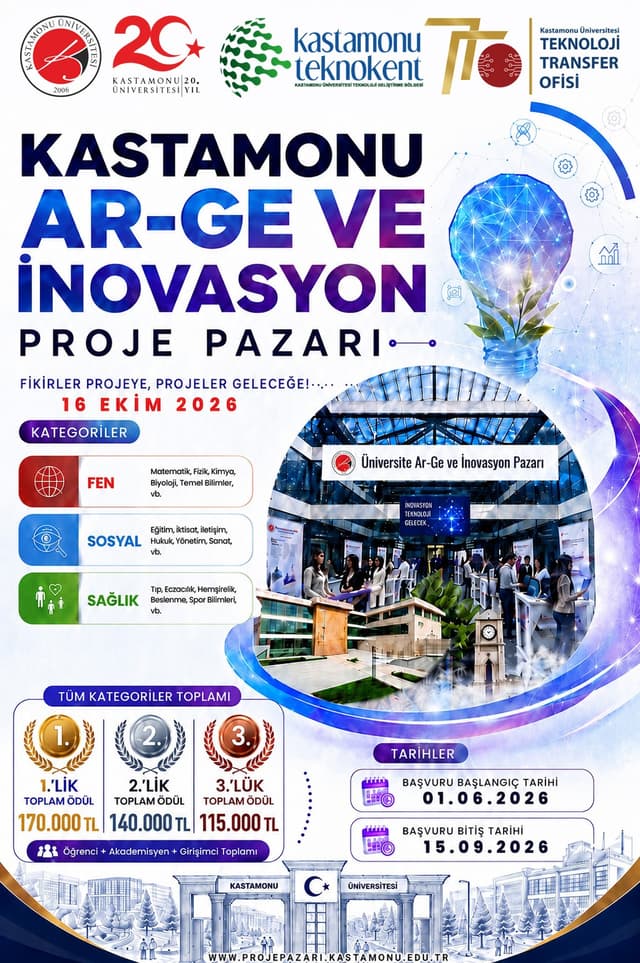
 Kastamonu R&D and Innovation Project Market
 Kastamonu Teknokent
 By Numbers Kastamonu University


 Central Cafeteria
 Guesthouse
 Parlayan Yıldız