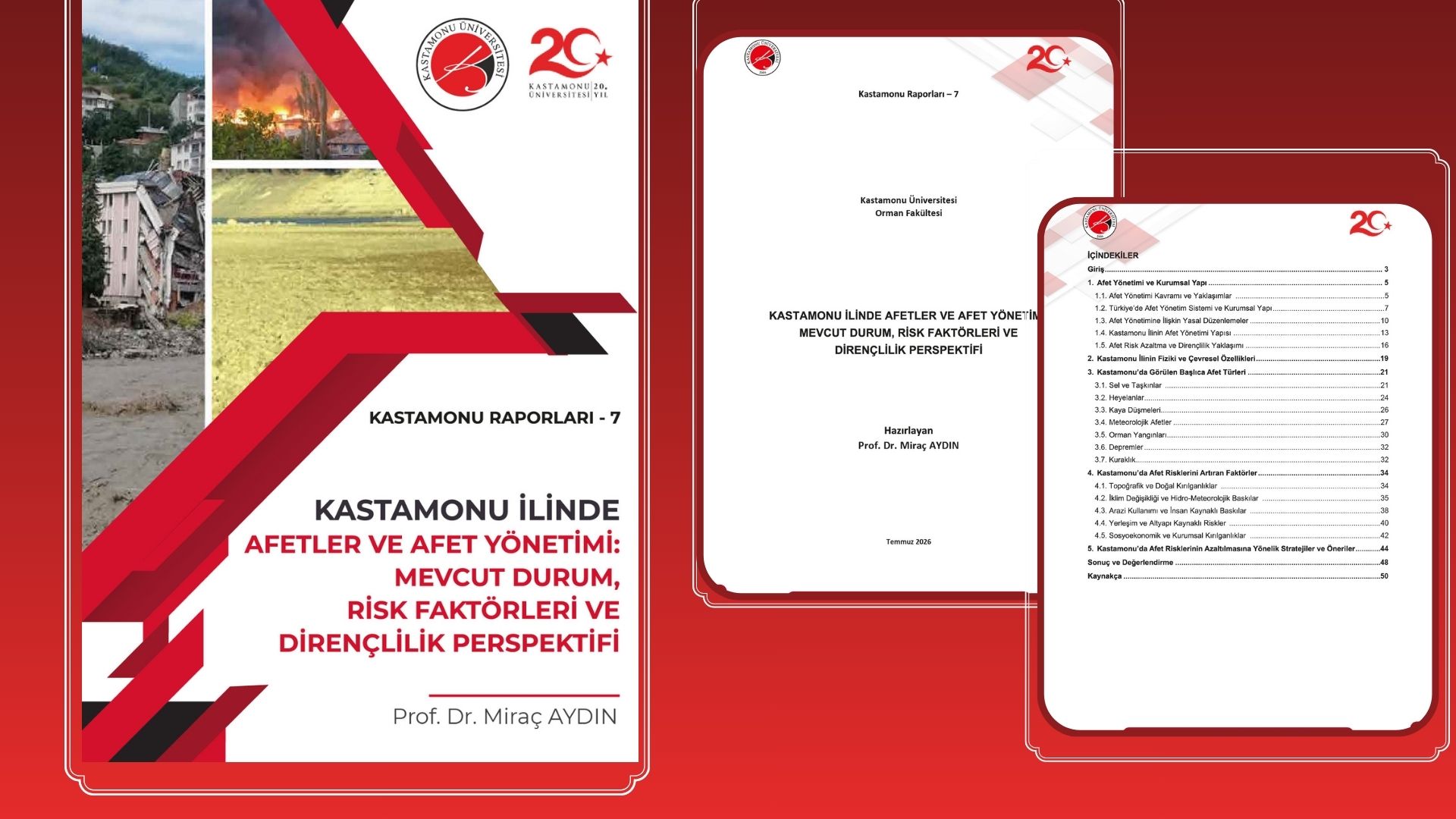
The seventh study of the Kastamonu Reports Series, prepared by Kastamonu University to provide scientific contributions to the city's social, economic, and environmental structure, has been published. The report titled "Disasters and Disaster Management in Kastamonu Province: Current Situation, Risk Factors, and Resilience Perspective," prepared by Faculty of Forestry Faculty Member Prof. Dr. Miraç Aydın, evaluates Kastamonu's disaster risks in light of scientific data and includes comprehensive analyses and solution proposals for developing a disaster-resilient urban structure.
The Kastamonu Reports Series is designed to support decision-making by addressing Kastamonu's priority issues and areas for development from a scientific perspective. The seventh study in the series, "Disasters and Disaster Management in Kastamonu Province: Current Situation, Risk Factors, and Resilience Perspective," aims to contribute to the literature and the work of relevant institutions by evaluating Kastamonu's disaster risks with a holistic approach and proposing applicable policy recommendations.
In the first section of the report, the theoretical framework of disaster management is addressed, including an evaluation of the concept of disaster management, the disaster management system in Türkiye, legal regulations, the disaster management structure in Kastamonu, and approaches to reducing disaster risks and building resilience.
In the second section, the physical and environmental characteristics of Kastamonu and potential disaster risks are examined, while in the third section, the main types of disasters observed in the province—under the headings of floods and inundations, landslides, rockfalls, meteorological disasters, forest fires, earthquakes, and drought—are discussed in detail. In the study, the causes of disasters and their effects across the province are analyzed using scientific data, revealing Kastamonu's current disaster risk profile.
The report also evaluates the factors that increase disaster risks in Kastamonu under the headings of topographic and natural vulnerabilities; climate change and hydro-meteorological pressures; land use and human-induced impacts; settlement- and infrastructure-related risks; and socioeconomic and institutional vulnerabilities.
In the final section of the study, strategies and policy recommendations for reducing disaster risks are presented. The report highlights recommendations such as the widespread adoption of risk-focused planning, increased inter-institutional coordination, the promotion of resilient urbanization practices, the development of early warning systems, the enhancement of community-based disaster awareness, and the support of climate change adaptation policies.
In his evaluation of the published report, our Rector, Prof. Dr. Ahmet Hamdi Topal, stated that universities are not only institutions that produce knowledge but also solution partners that guide the future of the cities in which they are located.
Our Rector, Prof. Dr. Ahmet Hamdi Topal, also made the following remarks:
“With the Kastamonu Reports Series, we continue to reveal the potential, problems, and solution proposals of our province in various fields based on scientific data. Disasters are not only natural events today; they are an important issue that should be addressed with a holistic perspective, considering their social, economic, and environmental impacts. I believe that this report will be an important reference source for our public institutions, local governments, decision-makers, and researchers. The development of a disaster management approach based on scientific knowledge will contribute to the development of safer and disaster-resilient cities.”