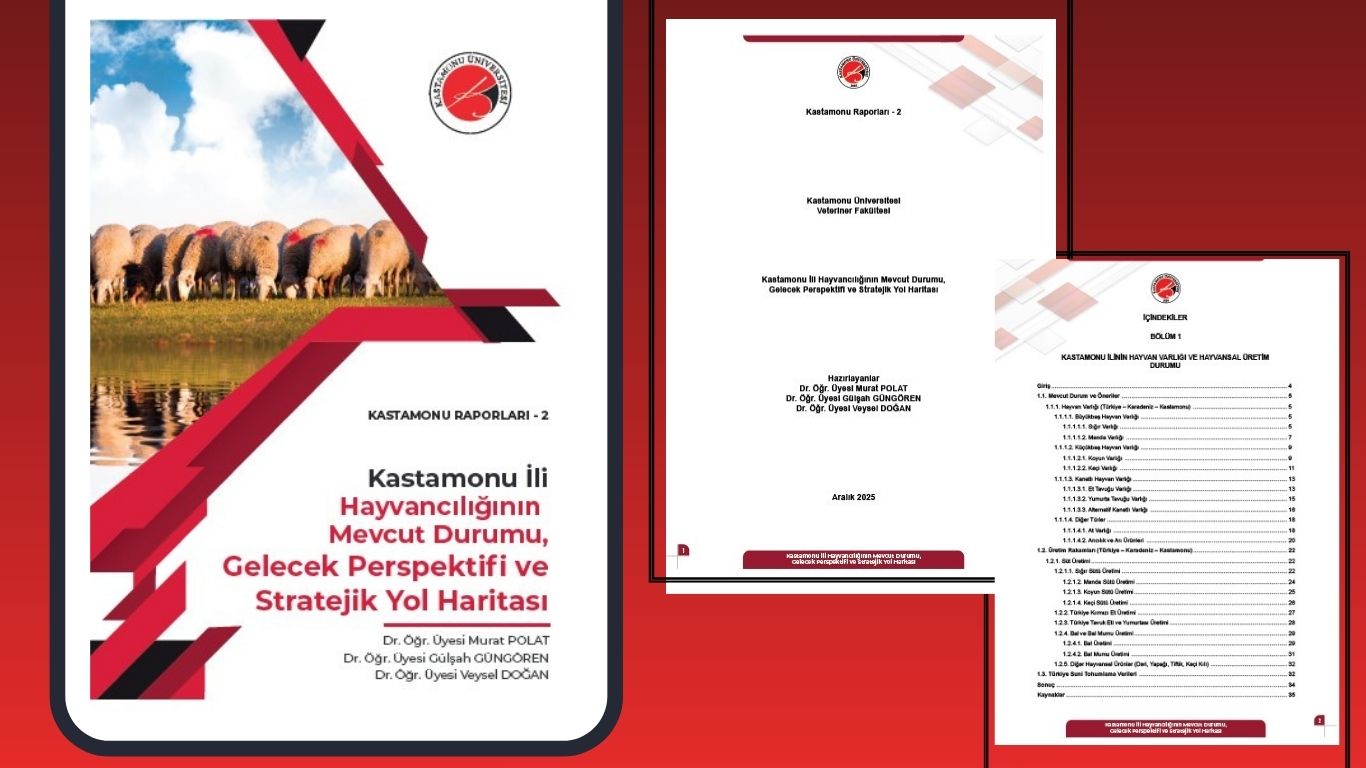
Kastamonu University shared the second study of the "Kastamonu Reports" series, which examines the city's socio-economic structure and strategic sectors in light of scientific data, with the public. The series' new report, titled "Current Status, Future Perspective, and Strategic Roadmap of Livestock in Kastamonu Province," was published, comprehensively examining livestock, which is one of our province's leading production areas.
In the report prepared by faculty members of our university's Faculty of Veterinary Medicine, Assist. Prof.Dr. Murat Polat, Assist. Prof.Dr. Gülşah Güngören, and Assist. Prof.Dr. Veysel Doğan analyzed the 20-year trend of livestock farming in Kastamonu between 2004 and 2024, using data from TÜİK. The study presented the province's animal production potential and detailed the structural problems encountered in the sector.
Stagnation in Animal Population and Regional Disparities
According to the report, while the cattle population across Türkiye has increased by approximately 67.8% in the last 20 years, the change in animal numbers in Kastamonu has remained limited. Stagnation in Animal Population and Regional Disparities. According to the report, while the cattle population across Türkiye has increased by approximately 67.8% in the last 20 years, the change in animal numbers in Kastamonu has remained limited.
A similar picture is also noticeable in small ruminant livestock farming. While the sheep population across Türkiye has increased significantly, in Kastamonu, the number of sheep decreased from 79,497 in 2004 to 57,666 in 2024. The report attributes this decline to the young population moving away from herding activities, low income levels, and problems with pasture management.
Stands Out Regionally in Milk Production
The report highlights that despite the stagnation in animal numbers, Kastamonu has shown a remarkable performance in milk production on a regional scale. According to the data, the province alone accounts for approximately 12.7% of the total milk production from cattle in the Black Sea Region. Kastamonu, demonstrating development above the Black Sea Region average (index 154) with an index of 175, holds a prominent position in regional production.
The increasing trend in beekeeping activities is also noteworthy. It is stated that the number of beehives, which was 47,904 in 2004, has increased to 88,665 as of 2024.
Strategic Roadmap and Future Recommendations
The report provides concrete policy and practice recommendations for the sustainable development of the livestock sector. The modernization of small-scale family businesses, increasing forage crop production, and conserving local genetic resources are among the priority topics. Additionally, attention is drawn to the importance of disseminating digital management systems and directing the young population toward the sector, in light of risks such as climate change, high input costs, and the aging of the rural population.
In his assessment of the report, our Rector, Prof. Dr. Ahmet Hamdi Topal, stated that the Kastamonu Reports series is a significant study that combines our University's academic expertise with the needs of the city.
Stating that the livestock report reveals Kastamonu's production capacity and the main problems in the sector, based on scientific data, our Rector said, "This report not only reveals the current situation of our province in the field of livestock but also offers a viable roadmap for the future."
Our Rector emphasized that they will continue to conduct scientific studies that prioritize local development, are data-driven, and are practical.
You can access the report here.