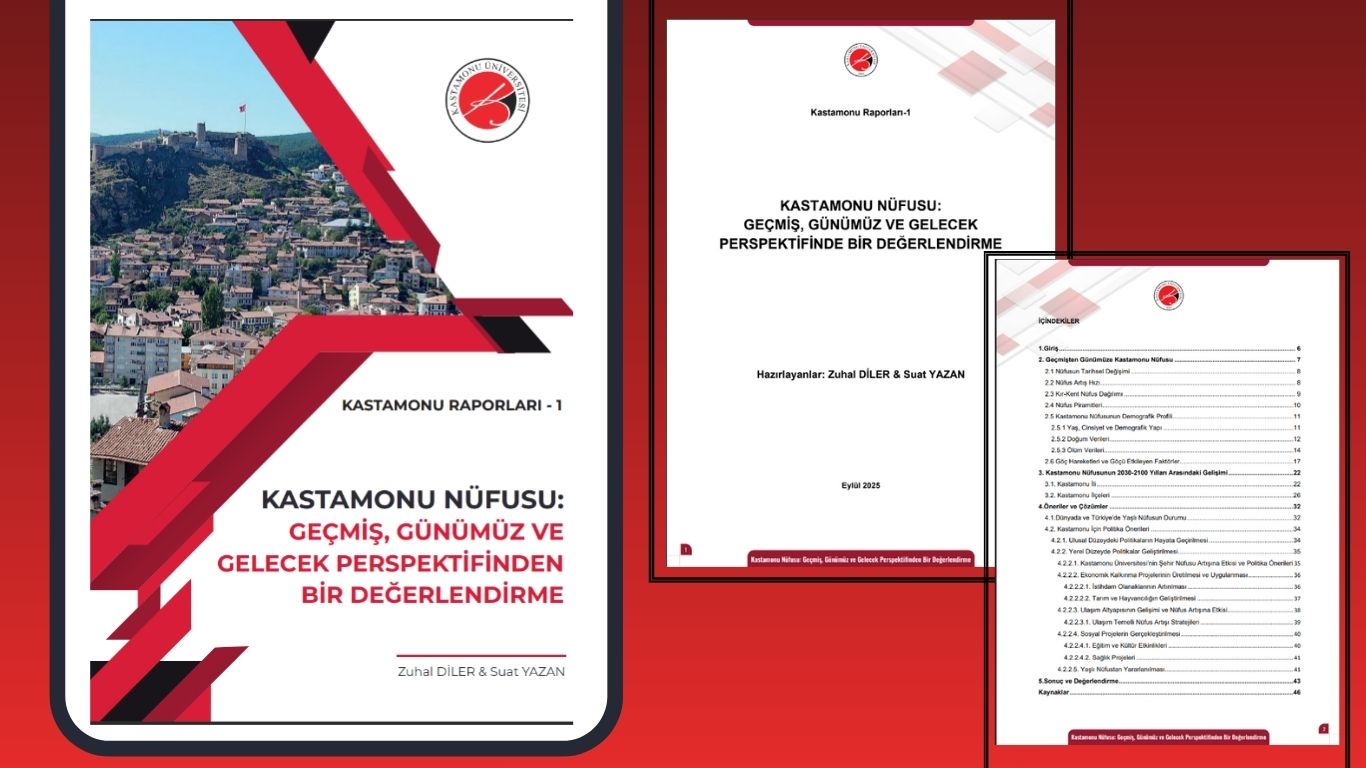
Kastamonu University has launched the "Kastamonu Reports" series, which aims to comprehensively address issues related to the city's history, geography, social, economic, demographic, scientific, cultural, artistic, sports, and tourism aspects in light of data.
The first publication of the series was a report titled "Kastamonu Population: An Evaluation from Past, Present, and Future Perspectives." The series will continue with new reports planned for future periods.
In the first report of the series, the population structure and historical development of Kastamonu were examined in detail. According to this, it was stated that the population of Kastamonu, which was 335,601 in 1927, reached its highest level of 450,946 in 1980, and then began to decline. As of 2024, the total population of the province was recorded as 381,991. The report also emphasized that Kastamonu is entering a demographic aging process. As the population ages, fertility data also reveals striking results. While the raw birth rate, which was 12.4 per thousand in 2009, decreased to 7.8 per thousand in 2023, the 32.8% drop in the number of births indicated that Kastamonu experienced fertility loss at a rate higher than the Turkish average. The report also extensively covered data on migration movements. It was stated that Kastamonu, which experienced significant population loss in the 1980s and 1990s, has recently shifted towards attracting migrants, and that the net migration rate reached its highest level in forty years, at 33.1 per thousand, during the 2022-2023 period.
In addition to the data, the report also highlighted Kastamonu's aging population structure and low fertility rate, offering policy recommendations at both the national and local levels. In this context, it was emphasized that family policies to encourage fertility should be implemented, employment opportunities increased, agriculture and animal husbandry developed, and health and care services for the elderly population expanded. Additionally, it was proposed to strengthen transportation infrastructure, improve the quality of life through education, culture, and health projects, and implement projects that would enable the elderly population to participate more actively in social life.
Our Rector, Prof. Dr. Ahmet Hamdi Topal, emphasized the importance of the study, stating, "The Kastamonu Reports series is an important initiative that brings together our university's scientific productivity with the future of our city. These studies are aimed at guiding Kastamonu in many areas, from its demographic structure to its economic development potential, and from its historical heritage to its tourism opportunities. The information presented will not only reflect the present but will also form the basis for future projections and planning. The wide-ranging recommendations presented in the report once again prove that our university is not only an institution operating in the scientific field, but also one that contributes to the city's future and works for the city. On this occasion, I would like to thank all our academics who contributed," he said.
You can access the full text and details of the report here.